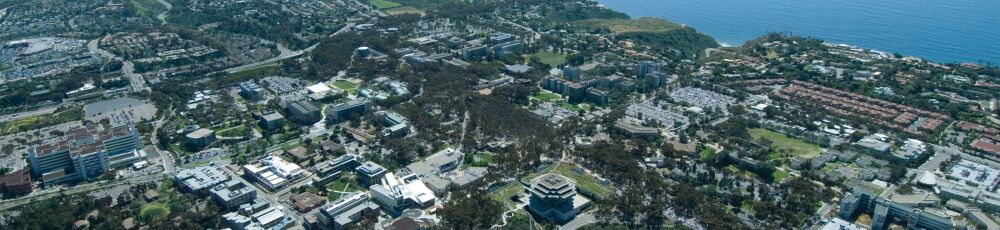
Credit: UC San Diego Publications | Copyright Regents of the University of California
Research Interests
I am broadly interested in computational methods and numerical analysis for control, optimization, design and uncertainty quantification of complex and large-scale systems. I work on using reduced-order models in the context of multifidelity and data-driven modeling, optimization and control, uncertainty quantification, reliability-based design, and design under uncertainty. I am affiliated with the Center for Extreme Events Research (CEER) as well as the Center for Computational Mathematics (CCoM). Here is a short bio and a longer CV
Contact
Boris Krämer
Associate Professor
Department of Mechanical and Aerospace Engineering
University of California San Diego
Jacobs Hall (EBU1) | Room 4209
9500 Gilman Drive | La Jolla | CA 92093-0411
- +1 (858) 246-5327
- bmkramer at ucsd dot edu
- https://www.linkedin.com/in/kramerboris
- Google Scholar: Papers and citations
- ResearchGate: Published research and discussions
- ORCiD: Persistant digital identifier
-
 Publons: Peer-reviewing profile
Upcoming events
September 28-30, 2026: I'll be participating in the Working Group on Digital Twins for Complex Systems: Theory and Algorithms at the Santa Fe Institute in New Mexico. Thanks to SFI for their support and Karen Willcox, Omar Ghattas and Bart van Bloemen Waanders for the invitation. October 1, 2026: Looking forward to give a seminar at the Department of Aerospace and Mechanical Engineering at University of Arizona.Recent Recorded Talks
For a summary of our research and papers, you may want to check out some of my recent recorded talks:April 16, 2026: I gave a talk Lift & Learn: Scientific ML for nonlinear conservative partial differential equations as part of the long program on Multifidelity Methods for Fusion Energy at the Institute for Pure and Applied Mathematics (IPAM).
March 12, 2026: I gave a 75 minute Tutorial: Robust Design Optimization as part of the long program on Multifidelity Methods for Fusion Energy at the Institute for Pure and Applied Mathematics (IPAM).
November 7, 2025: Data-driven Lagrangian reduced-order models and control of soft swimming robots as part of the Data-Driven Science and Engineering Seminars at the AI Institute in Dynamic Systems at UW.
October 29, 2025: Nonlinear control and balanced truncation model reduction for high-dimensional systems [VIDEO UPLOADED SOON] as part of the Optimal Control and Decision Making Under Uncertainty for Digital Twins workshop at IMSI (Institute for Mathematical and Statistical Innovation) in Chicago.
January 8, 2025: Structure-Preserving Learning of High-Dimensional Lagrangian and Hamiltonian Systems (video and slides) as part of the workshop on Computational Learning for Model Reduction at the NSF-sponsored Institute for Computational and Experimental Research in Mathematics (ICERM) at Brown University. I gave an earlier version of this talk at the Data-Driven Physical Simulation (DDPS) seminar organized by Youngsoo Choi (Lawrence Livermore National Laboratory)
April 9, 2024: Bayesian Inference and Global Sensitivity Analysis for Ambient Solar Wind Predition (talk by Opal Issan) as part of the Machine Learning for Planetary and Space Physics seminar.
Recent News
September 4, 2026: We just posted a paper on Stochastic Operator Inference for reduced-order modeling of capillary wave turbulence using experimental measurements, led by graduate student Hyeonghun Kim. This paper started from a collaboration of our experimentalist colleagues Prof. James Friend and Lei Zhang who produced 5TB of Experimental Datasets of Capillary Wave Turbulence in a Micro-Scale System. From this data, we made a stochastic reduced-order modeling choice and show in the paper how to process and learn models that are fully stochastic from this dataset.
September 4, 2026: A new paper Uncertainty quantification of fatigue initiation life for powder bed fusion metal additive manufacturing, led by Postdoc Yulin Guo just posted on arxiv. As part of the multi-institution DAPRA SURGE program, we develop a fast UQ surrogate model for fatigue life prediction of coupons printed at Auburn University with laser-powder-bed fusion additive manufacturing. We use data from electron backscatter diffraction for the microstructure and X-ray CT for defect data to process through a model chain and obtain uncertainty-quantified fatigue life estimates.
August 7, 2026: Our paper Parametric Operator Inference to Simulate the Purging Process in Semiconductor Manufacturing appeared in IEEE Transactions on Semiconductor Manufacturing. This paper was co-authored by graduate student Hyeonghun Kim and led by Dr. Seunghyon Kang. Dr. Kang spent a year-long sabbatical from Samsung Electronics Co., Ltd at our group from March 2024-March 2025. His work at Samsung is mainly on process control monitoring, and he was interested in leverating reduced-order modeling to speed up that process. During that year, we worked on data-driven ROMs in the parametric regime via Operator Inference. The CFD simulations had 1.25M degrees of freedom, and he was able to significantly speed up the analysis. We are looking forward to working with Dr. Kang to integrate into Samsung's processes.
August 1, 2026: Welcome to our new Postdoc Fredy Ramirez, who will be working on developing data-driven methods, scientific machine learning, and reduced-order models to improve ocean state estimation and uncertainty quantification. He will be co-advised by Profs. Geno Pawlak and Oliver Schmidt. Prior to joining the group, Fredy obtained his Ph.D. in Physics (under the direction of Professor Pat Diamond) from the University of California San Diego, where he developed a unified theoretical framework for the formation and persistence of layered transport structures using a hierarchy of reduced physical models.
July 19 - 24: It was a busy week at the 17th World Congress on Computational Mechanics where our group presented four talks:
- I gave a talk on "Towards Digital Twins for Control of Soft Robots" in MS131A Mathematics of Digital Twins: Challenges, Methods, and Applications I and was chairing the afternoon session MS131B Mathematics of Digital Twins: Challenges, Methods, and Applications II.
- I also co-organized (with Benjamin Peherstorfer) the session MS016A Scientific Machine Learning for Nonlinear Model Reduction I and PhD Student Hyeonghun Kim gave a talk in the second MS on MS016B Scientific Machine Learning for Nonlinear Model Reduction II.
- I co-organized and chaird (with Alex Gorodetsky) two sessions: MS171A Surrogate and multifidelity enhanced optimization under uncertainty I and MS171B Surrogate and multifidelity enhanced optimization under uncertainty II.
- I co-organized (with Daniel Straub, Iason Papaioannou) and chaired the session on MS139A Optimization under Uncertainty I.
- Former undergraduate student Juan-Diego Draxl Giannoni presented joint work on "Structure-preserving Lift & Learn: Scientific machine learning for nonlinear conservative partial differential equations" MS106C Advances in Model Order Reduction: Bridging Physics and Machine Learning III (Thu, 23/07/2026, 17:00 - 18:30, H4-4 (Alois)).
- I presented work on "Nonlinear Feedback Control in High Dimensions using the Polynomial-Polynomial Regulator" MS251B Optimal Control and Sensitivity Analysis II.
July 3: I presented work on "Data-driven Lagrangian reduced-order models and control of soft swimming robots" at the University of Almeria.
July 6 - 10: Postdoc Yulin Guo presented our recent work on "Probabilistic fatigue life prediction for selective laser melting additive manufacturing" at the World Congress on Reproducibility, Qualification, and Standards Development of Additive Manufacturing and Beyond (RQSD 2026) in Anaheim, CA.
June 30: I gave a seminar themed "Balanced truncation model reduction and control of high-dimensional nonlinear systems" at KTH Royal Institute of Technology in Stockholm hosted by Professor Johan Karlsson.
June 25, 2026: Congratulations to Albani Olivieri, who has been awarded the highly competitive 2026–2027 STEM Chateaubriand Fellowship! Sponsored by the Centre National de la Recherche Scientifique (CNRS) and the Chateaubriand Fellowship of the Office for Science & Technology of the Embassy of France in the United States, this prestigious fellowship supports outstanding doctoral students from U.S. institutions conducting part of their research in France. The program is highly selective and aims to foster scientific collaboration and strengthen research partnerships between the United States and France. You can read more at this LinkedIn Post.
June 21 - 26: Had a fantastic week at the Mathematisches Forschungsinstitut Oberwolfach for the workshop Mathematical Foundation of Digital Twins organized by Omar Ghattas, Matthias Heinkenschloss, Sebastian Reich and Claudia Schillings. Thanks for the invitation, and the many fruitful discussions and impressions.
June 12, 2026: Congratulations to Rachel McClow, who spent her senior year working in our research group to support research in modeling turbulence data. Rachel won a Jacobs School of Engineering Award of Excellence, a rare destinction given to only 6/1,300 graduating engineering students. You can read more about this here: Outstanding engineering, computer science undergraduates honored with Awards of Excellence.
March 9 - June 12: I was a Senior Fellow to the Institute for Pure and Applied Mathematics (IPAM) for its Long Program Multi-Fidelity Methods for Fusion Energy. IPAM is a truly unique place, and through their long program, I was able to meet colleagues outside of my core research area with connections that will last a long time. As part of the program, there were five very exciting workshops around fusion energy and computations, bringing in experts from around the world.
May 31 to June 5: I virtually participated in the workshop Integrating Data- and Physics-Driven Methods for Decision Making under Uncertainty at the Casa Matemática Oaxaca (CMO).
May 25 - 29: It is nice to see the self-organization in our community, especially among young researchers. Second-year PhD student Albani Olivieri attended the Young Mathematicians in Model Order Reduction Conference (YMMOR 2026) in Blacksburg, VA and gave a a talk on the theory and algorithms of lifting transformations for dynamical systems (PDEs and ODEs).
May 26 - 29: The 2026 American Control Conferencewas in New Orleans. Third-year PhD student Steven Nguyen presented his paper on "Reachability Analysis for Design Optimization" (with Jorge Cortes) and also third-year PhD student Dylan Hirsch presented his paper "Viscosity CBFs: Bridging the Control Barrier Function and Hamilton-Jacobi Reachability Frameworks in Safe Control Theory" (with Sylvia Herbert and Jaime Fernandez Fisac).
May 22: Our survey article (with Elizabeth Qian) themed Reduced-order modeling for engineering systems: survey and opportunities for digital twins appeared as part of a special issue in the Journal of Structural & Multidisciplinary Optimization (SAMO). While it is impossible to discuss every paper in a very active and long-standing field of model reduction, we tried to keep the focus on promising directions for digital twins, especially for engineering. We hope this article is a useful introduction to model reduction for those wanting to learn more, and a reference for people looking to dig deeper into some areas of model reduction.
May 18 - 22: I presented a talk on "Solution of generalized tensor Lyapunov equations arising in optimal control and model reduction" at the 27th Conference of the International Linear Algebra Society (ILAS 2026) in Blacksburg, VA. Thanks to Steffen Werner and Ionut Farcas for the invitation all all the organizers for such a wonderful conference.
April 28: We just posted our paper Reachability-Based Design Optimization for Aircraft Maneuverability on arXiv. This work is led by 3rd-year PhD student Nick Corbin and funded by the AFRL–UCSD Collaborative Center for Optimal Risk-quantified and robust Design of aerospace vehicles. In the paper, we include state-space based reachability analysis into the design of next-generation aircraft. This avoids the complicated back-and-forth between control and design teams, and allows for better control performance of the final design as the aircraft will have been conceptually designed with control in mind. Steven will present the theoretical underpinnings of this work at the American Control Conference 2026 in May.
April 24: We just posted our paper Nonlinear balanced truncation model reduction through scalable Taylor series on arXiv. Led by 5th-year PhD student Nick Corbin, this work provides a complete framework to go from a high-dimensional nonlinear control-affine system (with polynomial dynamics) to a nonlinear fully balanced reduced-order model. A main focus of Nick's work has been on reviving the beautiful nonlinear balancing theory and making it computationally feasible for large-scale systems through his clever numerical linear algebra approaches and Taylor series approximations.
March 30: I gave a Mathematics seminar talk at the California State University-Channel Islands.
March 16 - 18: I participated at the second Advances in Digital Twins workshop (Ai-DT) at Stanford University. My talk will be on "System-theoretic Reduced-order Digital Twin Prototypes", based on work led by 5th-year PhD student Nick Corbin.
Feb 18, 2026: Our joint paper Multifidelity Monte Carlo for the estimation of spacecraft re-entry windows appeared in Advances in Space Research. This is the result of (now Dr.!) Yannick Szamfater Garcia visting our group and Prof. Rosengren's group last year to work on using advanced UQ methods for spacecraft reentry predictions and orbital mechanics.
Feb 4, 2026: Together with my UCSD robotics colleague Professor Mike Tolley from the Bioinspired Robotics and Design Lab, we co-authored a SIAM Blog article on Data-driven Model Reduction to Control Soft Swimming Robots.
I serve on the editorial board for the Special Issue on Reduced Order Modeling, Generative AI, and SciML in Digital Twins in Structural and Multidisciplinary Optimization (SAMO) and we are looking forward to finalizing this exciting and timely special issue.
Jan 5 - Feb 5, 2026: Dr. Jesper Schröder visited our group from the Johann Radon Institute for Computational and Applied Mathematics in Linz, Austria. Jesper is an expert in minimum energy estimation for nonlinear system and interested in fast numerical realizations thereof.
November 7, 2025: I visited the University of Washington and gave an in-person talk at the Data-Driven Science and Engineering Seminars organized by the AI Institute in Dynamic Systems. Thanks to my host Prof. Steven Brunton.
November 6, 2025: Our new paper Dynamic Shape Control of Soft Robots Enabled by Data-Driven Model Reduction just appeared on arxiv. In this collaboration with Prof. Mike Tolley's lab, we are built a high-dimensional nonlinear FEM model and generated the largeEel-inspired Soft Robot Dynamic Structural Simulation Dataset, which is publically available for others to experiment with. Through the Lagrangian Operator Inference method we generated reduced models, and designed both an observer and model-predictive controller for tracking bioinspired and experimental trajectories. This was a fun collaboration with our robotics colleagues!
October 27-31, 2025: I participated in the Optimal Control and Decision Making Under Uncertainty for Digital Twins workshop at IMSI (Institute for Mathematical and Statistical Innovation) in Chicago. Thanks to the organizers and NSF for supporting the institute.
October 14, 2025: Exciting to see graduated Ph.D. student Nate Linden have his third journal paper Systems modeling and uncertainty quantification of AMP-activated protein kinase signaling appear in npj Systems Biology and Applications. His prior work was also highlighted in a public science article A new framework for trusting modeling predictions in biology.
October 7, 2025: Two firsts! Congrats to graduate student Hyeonghun Kim for having his first journal paper Physically consistent predictive reduced-order modeling by enhancing Operator Inference with state constraints published in JCP. In this work, we added physics-preserving constraints to the Operator-Inference learned ROMs, so that species and reaction constraints are always enforced. The nice by-product is that this generated long-term stable models, too! Moreover, undergraduate student Juan Diego Draxl Giannoni, together with former Postdoc Harsh Sharma had their article Nonlinear energy-preserving model reduction with lifting transformations that quadratize the energy appear in Physica D: Nonlinear Phenomena. In this article, we continue our work on finding auxiliary lifting variables to rewrite non-polynomial systems in quadratic form (doing so exactly, without approximation), this time with a constraint on the transformation so that the lifted system remains energy conserving.
September 22, 2025: Welcome to new graduate student Shelby Pullen, who joins us from George Washington University. Shelby will be working on reduced-modeling and uncertainty quantification for metamaterials, manufactured with metal-additive methods. She'll be part of the Center for Simulation and design of Heterogeneous Architectures for Performance and Energy absorption (SHAPE).
September 22-26, 2025: What an honor that 5th-year graduate student Opal Issan presented an invited semi-plenary at the 3rd Machine Learning in Heliophysics Conference in Madrid, Spain.
September 4, 2025: We are excited to be part of DOE's Predictive Science Academic Alliance Program (PSAAP IV) with a Center for Advancing the Radiation Resilience of Electronics (CARRE), led by Oregon State University, and a Center for Simulation and design of Heterogeneous Architectures for Performance and Energy absorption (SHAPE), led by UCSD. For the former, our group will be working on surrogate modeling for radiation transport and uncertainty quantification, and for the latter on reduced-order modeling and topology optimization under uncertainty for shock-absorbing metamaterials.
August 28, 2025: Congratulations to graduate student Opal Issan presented a poster at the Conservative projection-based data-driven model order reduction of a fluid-kinetic spectral solver hosted by the MIT Plasma Science and Fusion Center.
August 24, 2025: Fourth-year graduate student Nick Corbin gave a talk on "Feedback Control of Nonlinear Systems Using The Polynomial-Polynomial Regulator" as part of the PDE control workshop at the 9th IEEE Conference on Control Technology and Applications (CCTA) here in San Diego.
August 18-22, 2025: Graduate student Opal Issan presented a poster at the 6th Computational Physics School for Fusion Research hosted by the MIT Plasma Science and Fusion Center.
August 11, 2025: Congratulations to graduate student Nate Linden for having his second journal paper Increasing certainty in systems biology models using Bayesian multimodel inference appear in Nature Communications.
August 11-15, 2025: I attended the workshop Mathematical and Computational Foundations of Digital Twins at the Centre International de Rencontres Mathématiques (CIRM) in Luminy, France. My presentation on "Nonlinear control and balanced truncation model reduction for high-dimensional systems" covered recent work on our AFOSR MURI on "Mathematics of Digital Twins." Thanks to Houman Owhwadi and the other organizers for such a nice focused workshop.